
Desi Doggie
You get the impression you have a choice in the personality you bring home (Wouldn’t it be great if you could do the same with children?).

You get the impression you have a choice in the personality you bring home (Wouldn’t it be great if you could do the same with children?).

I couldn’t imagine the horror of explaining to my feminist friends that I had found my husband on an online wedding bureau.

Marriage is a choice you make. Not just on your wedding day, but every day, over and over again. We often forget this simple fact, the most difficult of ones to endure.

We’ve started to find that maybe love really is important, that it doesn’t always have to come after marriage, and that independence can be a virtue. But there is still a gap to bridge.

“In an Indian culture there is more closeness, involvement and warmth.” South Asian Parent talks to Sheila Natesan about her son’s cross-cultural marriage to an American.

The first we heard of a potentially serious relationship between our daughter, Indian by origin and broadly Hindu in religious inclination, and her friend, of Pakistani origin and Muslim by religion of birth, was through her email.

We can clink glasses to cross-caste marriages, smile politely at cross-cultural couples…But if ‘conversion’ comes up, we fall nothing short of an obvious eye-widen and a suppressed gasp. “Did she really convert for him?”

Mita married Nick eleven years ago—an Indian girl living in England found a life partner in a sensible, charming British man. They crossed cultural boundaries at a time when it wasn’t commonplace.
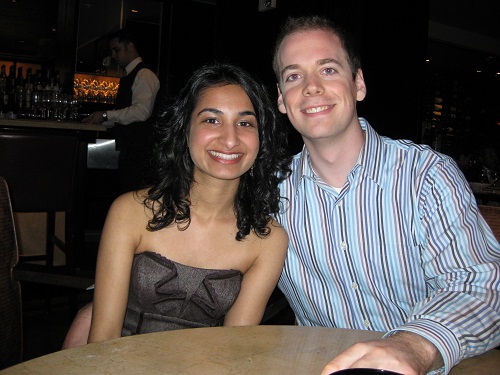
I was nervous to tell my dad I was dating Chris. I didn’t want to in the first place, but Chris was starting to get offended. I can’t remember how I brought it up on the phone, but I do remember how my dad responded.

Half-half is an identity Anya and her mother Mita have created for themselves amidst a world of sticky labels and even stickier social rules. Contrary to the fear that children of cross-cultural couples will lose a part of their parents’ culture, Anya is an example of the opposite.
Once rare, but now increasingly common, is the phenomenon of Desi girls dating non-South Asians. There are an increasing number of girls, like myself, who have crossed their parents and dated someone who on face value was not an ideal match.

Rimi Kochar says it like it is. She raised two daughters in Indonesia, the younger of whom has been ‘romantically connected’ with an Australian man for four years. She is Indian by origin, but bound by no borders.